The lightweight workspace
for startups.
Built for small and medium teams moving fast.
Mehashi is a lightweight project-management workspace for startups; free for up to 5 people, then £1/$1/€1 per seat per month. Small teams plan work as tasks across board, list, timeline and calendar views, with notes, files and links kept per project. No required fields, no workflow ceremony, and no per-project add-ons to buy.
- Free plan
- 5 people per workspace, forever — not a trial
- Every seat after that
- £1 / $1 / €1 per month, the same number in each currency
- So a team of 12
- Pays for 7 seats — £7 a month
The features you need.
None of the ones you don't.
All included in the free plan.
We built Mehashi because heavyweight project tools feel like overkill for a team of twelve. Every feature below earns its place on the roadmap by saving a startup at least an hour a week.
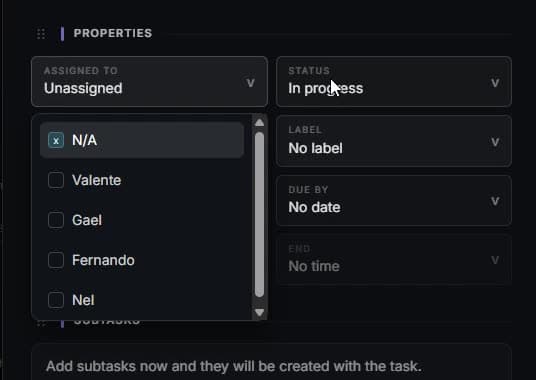
Tasks, not tickets
Capture work in seconds. No required fields, no ceremony. Just a title, an owner, and a date if you want one.
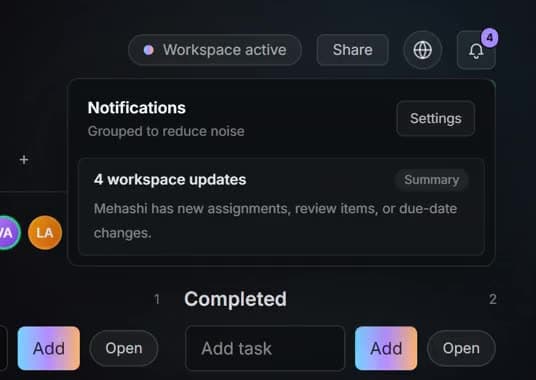
Easy notifications
Assignments, reviews, and due dates land in one bell. When updates pile up they group into a single summary instead of pinging you four times.
Signal over noise
See what's blocked, stalled, or ready for review at a glance. No notification tsunamis, no Slackbot firehose. Just the three things that changed today.
Three views, one source
Board for sprint planning, timeline for roadmaps, list for everything-at-once. Same tasks, different lenses. Pick what your brain wants today.
Talk where the work is
Every task has comments with attachments, and every project has its own notes, links, and files. Decisions stay next to the tasks they're about — not lost in a channel.
Fair pricing, forever
Free for your first five people. One currency unit per seat after that: £1, $1 or €1. No annual commit, no enterprise sales call.
Plan on Monday Morning.
Ship by Monday Afternoon.
From the daily standup to the quarterly review: the same tasks, the same people, the same source of truth.
Every team's work, one pane.
Roll up sprint progress across engineering, design, and growth without asking three people on Slack. Filter by person, squad, or shipping window.
Set up in an afternoon.
No onboarding call. No professional services quote. No three-week migration plan.
Invite your team
Invite teammates by email. First five seats are always free, so you can trial with a squad before the whole company piles in.
Bring your work over
Add tasks as you go — a title is enough to start. Most teams have their first board running in under five minutes.
Start shipping
Open the board, drag a task to “In progress”, and get back to work. There is no step four.
The kind of thing we hope
to hear a year from now.
Mehashi is still being built. These quotes are the reactions we're designing for, when the product is ready and the first real teams have used it for a while.
We cancelled Jira the week we rolled out Mehashi. Three engineers said thank you in the same standup. I'd never seen that before.
The £1-a-seat pricing is what sold the CFO. Everything else sold the team.
I used to dread Monday planning. Now it's a twenty-minute thing. That's all I wanted from a project tool, honestly.
How we stack up.
We won't pretend Mehashi does everything Jira does. We will pretend you don't need most of it.
| Feature | Mehashi | Jira | Asana | Linear |
|---|---|---|---|---|
| £1 / $1 / €1 per seat, same number | Yes | From ~$8 | From ~$11 | From ~$10 |
| Free for first 5 people, forever | Yes | Up to 10 | Up to 2 | Unlimited, 250 issues |
| Setup in under 15 minutes | Yes | No | Yes | Yes |
| Board, list, and timeline views | Yes | Yes | Timeline on paid plans | Board, list, cycles |
Competitor prices are approximate published per-user monthly rates as of August 2026 — check their sites for current numbers.
Pay per seat,
but just a pound.
Free for your first five people. After that, one pound, dollar, or euro per seat per month, the same number in every currency.
For teams getting started
- Up to 5 people, no time limit
- Unlimited tasks & projects
- Board, list, timeline & calendar
- Task comments, notes, files & links
- Community support
A pound a seat. That's the pitch.
- Same number in $ and €
- Everything in Free
- Grow past 5 — pay only for extra seats
- Email invitations & daily digests
- Priority human support
For when you've hired faster than planned
- Everything in Team
- Volume discounts at 100+ seats
- Granular project roles
- A direct line to the founders
How does the £1/$1/€1 per seat pricing actually work?
Your first 5 teammates are free, forever. After that, every additional seat is one pound, one dollar, or one euro per month, billed at the same number in your currency — £1, $1 or €1, not an exchange rate. A team of 12 pays for 7 seats. Add someone mid-month, we prorate; remove them, we credit the difference.
What happens when we outgrow Scale?
We haven't seen it yet, but if you get there, we'll build you a plan that makes sense. No six-figure ACV minimum, no mandatory annual commit.
What if we need custom workflows?
Mehashi ships four statuses — Todo, In progress, Check, Done — and they are the same in every workspace. You can add, rename and remove board columns per project to match how your team moves work, but there are no custom statuses, custom fields or automation rules. Mehashi is deliberately light on process.